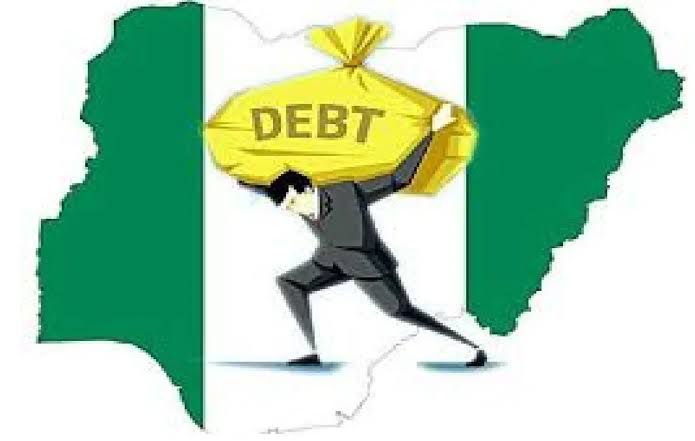
Nigeria’s total public debt climbed to N159.28 trillion ($110.97 billion) as of December 2025, according to figures released by the Debt Management Office (DMO).
A breakdown of the data shows that domestic debt stood at N84.85 trillion ($59.11 billion), while external debt amounted to N74.43 trillion ($51.86 billion), as reported by the News Agency of Nigeria (NAN).
READ MORE :Gwamna Declares 2027 Gombe Governorship Ambition, Submits APC Letter of Intent
This indicates that domestic borrowing remains the larger share, accounting for 53.27 per cent of the total debt stock, while external borrowing represents 46.73 per cent.
The DMO noted that the total debt figure includes both domestic and external borrowings by the Federal Government, as well as those of the 36 states and the Federal Capital Territory (FCT).
Further analysis shows that the Federal Government holds the bulk of the debt, with N80.49 trillion in domestic obligations and N66.27 trillion in external liabilities. In contrast, the 36 states and the FCT collectively owe N4.36 trillion domestically and N8.16 trillion externally.
According to April data from the International Monetary Fund (IMF), Nigeria’s debt-to-GDP ratio is projected to decline to 32.3 per cent in 2026, down from 35.5 per cent in 2025. Although this remains below the 60 per cent global benchmark, analysts warn that the high cost of servicing debt relative to government revenue continues to pose a major challenge.
External debt is categorised into three main groups based on the type of lender. Multilateral loans account for $23.19 billion, representing 45 per cent of the external debt. These are concessional loans provided by international financial institutions.
Nigeria’s largest external creditor is the World Bank, with exposure of $18.3 billion. The country is currently the third-largest borrower from the World Bank’s International Development Association (IDA).
The African Development Bank (AfDB) is owed approximately $3.5 billion in outstanding loans.
Bilateral loans—credit obtained from individual foreign governments—stand at $6.20 billion, accounting for about 12 per cent of external debt.
On the domestic front, Federal Government of Nigeria (FGN) bonds remain the dominant instrument, making up roughly 80 per cent of local debt. This figure now includes securitised Ways and Means advances from the Central Bank.
About The Author