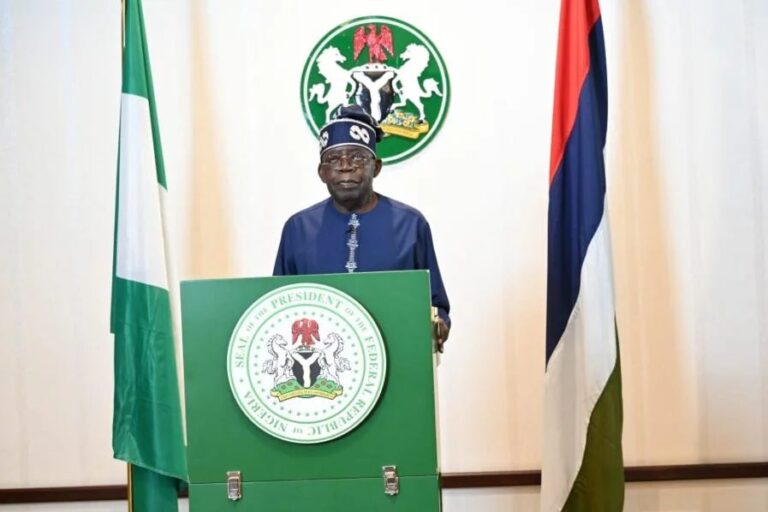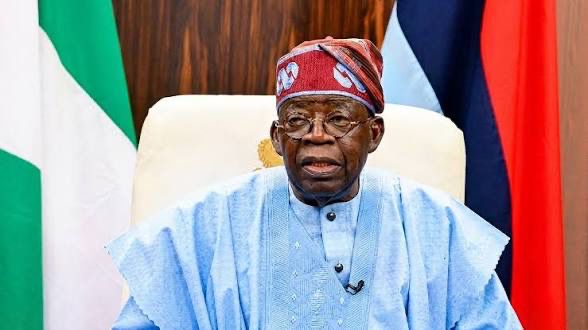
President Bola Tinubu has declared that individuals who fund, support, or facilitate terrorism in Nigeria will face uncompromising punishment, stressing that those responsible for violence, abductions, and bloodshed will not be spared.
The President also issued a stern warning to bandits, kidnappers, and terrorist backers, urging them to surrender immediately or confront the full strength of the Nigerian government. He revealed that security forces eliminated more than 13,000 terrorists within the last year.
READ MORE: Tinubu’s Democracy Day Message: Full Address to Nigerians
Tinubu made these remarks during his nationwide broadcast marking Nigeria’s 27th uninterrupted Democracy Day celebration and his fourth Democracy Day address since assuming office in 2023.
While noting that terrorism-related fatalities have dropped by 81 percent since 2015, the President said the nation’s celebration was overshadowed by the ongoing captivity of students and teachers abducted in Oyo and Borno states.
Addressing criminal groups directly, he stated: “Bandits, kidnappers, and sponsors of terror must either lay down their arms or face decisive action from the Nigerian State. The opportunity for surrender will not remain available indefinitely. Those who profit from the suffering and deaths of Nigerians should expect no compassion.”
Tinubu explained that Nigeria’s security strategy has evolved from international training partnerships with countries such as the United States, France, and other European nations to highly targeted military operations.
According to him, security forces successfully weakened the command structure of ISWAP in Arege, Borno State, contributing to a significant decline in terrorist activities.
“In the past year alone, over 13,000 terrorists have been eliminated,” he said.
Despite these successes, the President noted that rehabilitation programmes remain available for insurgents willing to abandon violence.
He disclosed that through Operation Safe Corridor, more than 124,000 former fighters and their family members have surrendered and disarmed since 2023.
Tinubu described the N5.41 trillion allocated to defence and security in the 2026 budget as evidence of the government’s determination to defeat terrorism and insecurity, challenges that have plagued the country for over a decade.
In addition to increased funding, he announced the recruitment of over 50,000 police officers alongside thousands of military personnel to strengthen the nation’s security architecture and address manpower shortages.
The President acknowledged that the continued abduction of schoolchildren and teachers in Oyo and Borno states, now entering its fourth week, has dampened the mood of this year’s Democracy Day celebration.
“Although our national spirit has been affected by the kidnapping of our children, we remain optimistic that they will return safely. A democratic society cannot thrive without security,” he said.
He reiterated that the administration had declared a security emergency and committed unprecedented resources toward protecting citizens.
Calling for unity, Tinubu urged Nigerians to avoid attributing criminal acts to any ethnic or religious group.
“At moments like this, we must reject division and blame. Criminality knows no tribe or faith. Together, we will overcome these threats and ensure that those seeking to destabilise our nation are defeated,” he said.
On the issue of electricity, the President outlined the severe challenges his administration inherited in 2023, including inadequate power generation, unstable gas supplies, weak transmission infrastructure, significant losses by distribution companies, and a metering shortfall exceeding four million units.
He explained that the sector was unable to fully utilise its installed capacity, resulting in insufficient power generation, transmission inefficiencies, poor distribution, and inadequate revenue collection.
To tackle these problems, Tinubu highlighted several reforms, including signing the Electricity Act, which grants states greater authority over power generation, transmission, and distribution.
He also disclosed that the Presidential Power Sector Task Force had been mandated to raise a N4 trillion bond to clear verified legacy debts while working to reduce the metering gap nationwide.
Furthermore, he said the Rural Electrification Agency, with support from the World Bank and African Development Bank, has expanded off-grid and mini-grid electricity projects to underserved communities, educational institutions, markets, and healthcare facilities.
“Reliable electricity is a basic benefit every Nigerian deserves, and we are committed to making it available across the country,” he stated.
Discussing the economy, Tinubu reported improvements in government revenue, enhanced fiscal accountability, and renewed investor confidence across key sectors, including agriculture, manufacturing, energy, technology, mining, transportation, and the creative industry.
He revealed that non-oil exports increased by 21 percent in the previous year, while more than 1,000 small and medium-sized enterprises obtained export certification. He also highlighted the National Agricultural Development Fund’s plan to deploy 10,000 tractors over the next five years to boost food production.
However, the President admitted that many citizens continue to face economic difficulties.
“Despite the progress recorded, numerous Nigerians are still experiencing hardship. Our focus remains on reducing inflation, increasing food supply, generating employment opportunities, improving living conditions, restoring economic confidence, and building a foundation for long-term prosperity,” he said.
Tinubu expressed confidence that the country is transitioning from economic uncertainty toward greater stability and growth, adding that the ultimate objective is to ensure that the benefits of democracy and economic reforms reach households, communities, and regions across Nigeria.
“We are laying the foundation for stronger growth and shared prosperity. Democracy should not only be visible in our institutions; it must also improve the everyday lives of our people,” he concluded.
About The Author