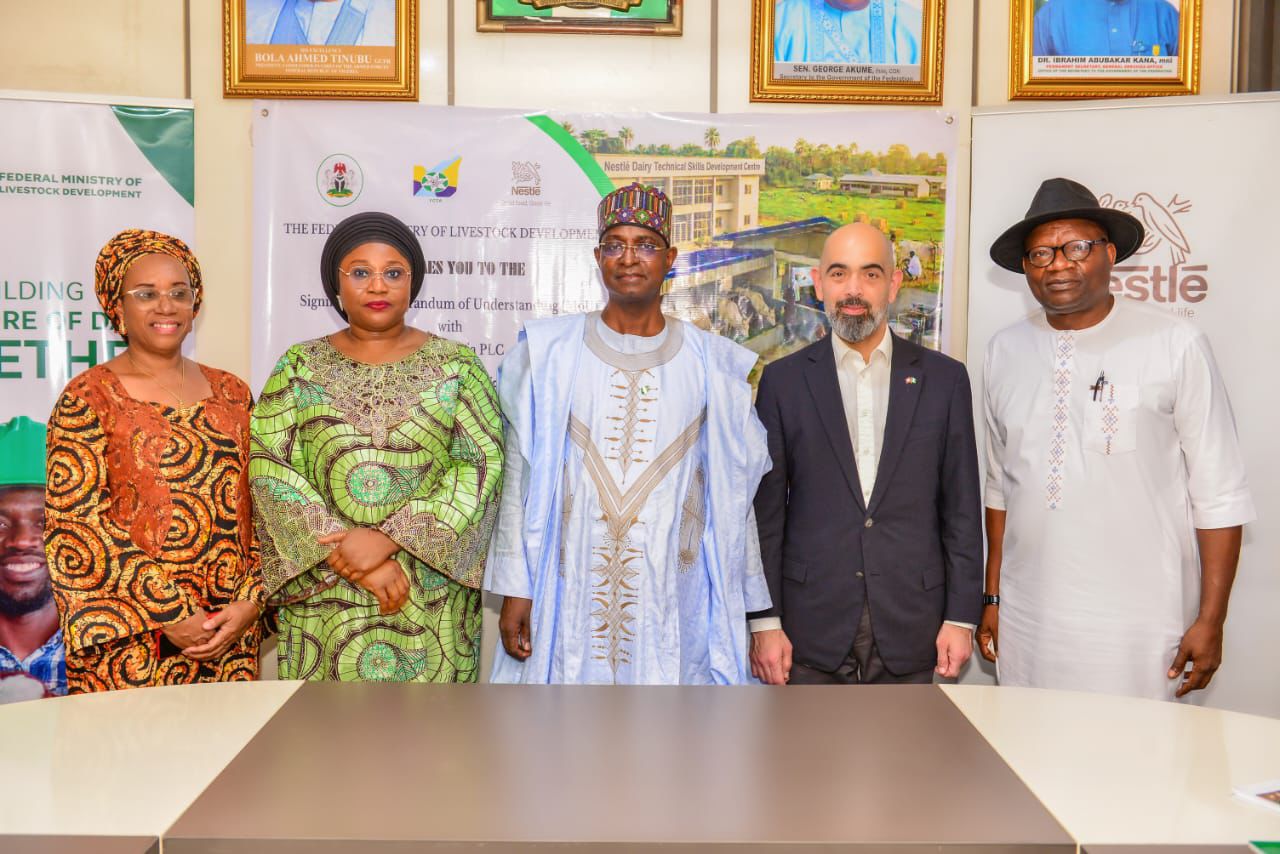
Nestlé Nigeria Plc has entered into a Memorandum of Understanding with the Federal Ministry of Livestock Development to establish a Dairy Technical Skills Development Centre in Paikon Kore, Gwagwalada. The initiative aims to boost technical expertise, improve milk quality, and increase productivity across Nigeria’s dairy sector.
The centre will be situated at the Nestlé Dairy Demonstration Farm and builds on the company’s ongoing Nestlé Livestock Development Project (NLDP). It represents a strategic progression of earlier initiatives, from the launch of the Demonstration Farm in 2025 to the signing of a Letter of Intent on World Milk Day 2025. Together, these steps mark a shift from pilot programmes to full-scale implementation and a more structured, scalable approach to skills development within the dairy value chain.
READ MORE:Trump declares extension of Iran ceasefire
The partnership will deliver structured training programmes and targeted interventions focused on:
Enhancing on-farm practices in milk production, processing, hygiene, and farm management
Developing industry-relevant technical skills in collaboration with key stakeholders
Improving coordination across the value chain and raising milk quality standards in local dairy clusters
Speaking at the signing ceremony, the Managing Director and Chief Executive Officer of Nestlé Nigeria Plc, Wassim Elhusseini, said the company has consistently worked to strengthen Nigeria’s dairy value chain.
“At Nestlé, our experience has shown that improved capability leads to better outcomes. This partnership with the Federal Ministry of Livestock Development enables us to expand our structured approach to building the skills needed to boost productivity, enhance quality, and ensure long-term sustainability in the sector,” he said.
He added that Nestlé’s investment in dairy development is designed to create shared value for communities while supporting a strong and resilient local supply base.
Since 2019, the Nestlé Livestock Development Project has engaged dairy communities across Nigeria to improve milk quality, increase productivity, and strengthen livelihoods. The initiative has established 83 dairy cooperatives, supporting over 3,000 milk producers and aggregating more than one million litres of raw milk. Additionally, over 2,000 pastoralists have been trained, more than 36,744 cattle vaccinated, and critical infrastructure introduced to support production.
Also speaking, the Minister of Livestock Development, Mukhtar Idi Maiha, highlighted the sector’s potential and the need to strengthen technical capacity.
“Nigeria’s dairy industry has significant potential, but unlocking it requires improved technical expertise across the value chain. This partnership is a practical step towards enhancing productivity and quality. I commend Nestlé Nigeria for its sustained commitment and track record through the NLDP, which demonstrates what can be achieved with the right systems in place,” he said.
The minister added that the government remains committed to creating an enabling environment that supports such investments, ensuring that policies and partnerships work together to deliver meaningful impact and build a more competitive and resilient dairy industry.
He noted that the initiative aligns with the objectives of the National Dairy Policy under the National Development Plan, which seeks to drive growth in the livestock and dairy sectors while improving food security and economic opportunities.
Following the signing of the agreement, both parties will proceed to the implementation phase, including finalising the training framework, preparing the demonstration farm site, and rolling out the programme in phases with relevant stakeholders.
The Dairy Technical Skills Development Centre will serve as a structured platform for training and capacity building, focusing on developing mid-level technical skills essential for the long-term sustainability of the sector.
By scaling proven interventions and strengthening technical capacity, the partnership is expected to support livelihoods, boost local production, and contribute to national development.
About The Author