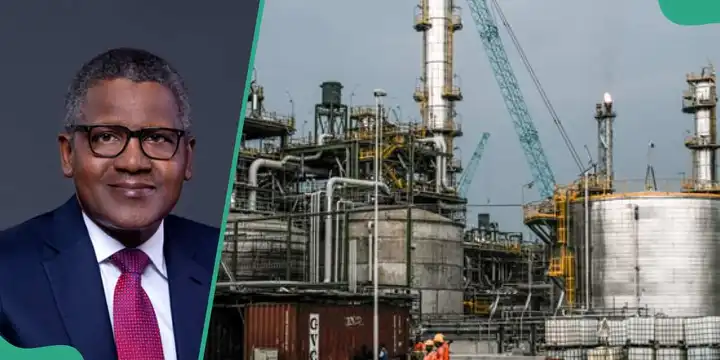
Dangote Industries Limited has kicked off early-stage activities for its planned $17 billion oil refinery in Kenya, a landmark project expected to become the largest refining facility in East Africa.
The proposed refinery, designed to process 700,000 barrels of crude oil per day, has moved beyond the planning phase. The company has selected the project site, commenced geotechnical investigations, and started engineering and design work ahead of full-scale construction.
READ MORE: Egypt Files FIFA Complaint Over Officiating After World Cup Loss to Argentina
According to Reuters, the refinery will be situated on Lamu Island along Kenya’s coastline. Construction is expected to last about three years, after which the facility will supply refined petroleum products to Kenya and neighbouring countries, reducing the region’s reliance on imported fuel.
The project follows a Bloomberg report on Tuesday indicating that President of Dangote Group, Aliko Dangote, intends to invest as much as $17 billion in the refinery as part of the company’s expansion into the East African energy market.
Quoting a spokesperson for Dangote Industries, Bloomberg said the proposed plant will mirror the company’s Lagos refinery and will have the capacity to refine approximately 700,000 barrels of crude oil daily upon completion.
The report stated that Africa’s richest businessman had assured the governments of Kenya and Uganda of his commitment to establish a refinery in East Africa similar to the one operating near Lagos. It also noted that the facility would require several years to complete.
Bloomberg further recalled that Kenyan President William Ruto announced in May that construction of the refinery would begin this year.
Speaking with Reuters, Dangote Industries’ Vice President for Oil and Gas, Devakumar Edwin, confirmed that significant progress had already been made.
“The site has been selected, soil tests are underway, and engineering and design activities have commenced. Kenya was always our preferred location,” Edwin said.
He added that the coastal town of Lamu was chosen for commercial and technical advantages, although no further details were provided.
The report also revealed that Tanzania had initially been considered before Kenya emerged as the preferred destination.
The refinery will represent Dangote Group’s largest refining investment outside Nigeria and forms part of its broader strategy to increase refining capacity across Africa following the successful commencement of operations at its 650,000-barrels-per-day Lagos refinery.
Edwin explained that funding for the Kenyan project would come from internally generated revenue, bond issuances and proceeds from the company’s planned initial public offering. While he declined to disclose the exact investment cost, he said it would be comparable to that of the Lagos refinery, which eventually exceeded $20 billion before operations began in 2024.
Reuters reported that the original estimate for the Lagos refinery stood at around $9 billion in 2013 but rose significantly due to site relocation, engineering complexities, currency depreciation, the COVID-19 pandemic and rising global inflation.
Alongside the Kenyan investment, Dangote is also expanding its Nigerian refinery. The Lagos facility is expected to double its refining capacity from 700,000 barrels per day to 1.4 million barrels daily by 2028, positioning it among the world’s biggest refining complexes.
Dangote Industries has also announced plans to increase its total refining capacity across Nigeria and Kenya to 2.1 million barrels per day as part of its long-term continental growth strategy.
Edwin disclosed the expansion during a visit by officials of the Republic of the Congo’s national oil company, Société Nationale des Pétroles du Congo, to the Dangote Petroleum Refinery in Lagos.
According to him, the group’s future refining portfolio will comprise 1.4 million barrels per day in Nigeria and the proposed 700,000-barrels-per-day refinery in Kenya, which will primarily serve East African markets.
He also revealed that Dangote Group intends to invest an additional $46 billion between 2026 and 2028 across its refining, cement and fertiliser businesses to accelerate industrial development across Africa.
Industry observers say the Kenyan refinery reflects the growing drive among African nations to strengthen local refining capacity in order to improve energy security, conserve foreign exchange and support economic growth.
Although Africa produces millions of barrels of crude oil every day, the continent has remained heavily dependent on imported refined petroleum products due to inadequate refining infrastructure.
Available data indicate that while Africa accounts for about seven per cent of global crude oil production, its refining capacity has declined considerably over the past two decades because of ageing facilities, limited investment and poor maintenance.
The successful operation of the Dangote Petroleum Refinery in Nigeria has started reversing that trend. The refinery reached full production shortly before heightened tensions in the Middle East, helping Nigeria cut fuel imports and improve domestic supply.
Its performance has encouraged governments and private investors across the continent to pursue similar projects. In Mozambique, businessman Benedict Peters has expressed interest in developing a proposed 200,000-barrels-per-day refinery, while Uganda is progressing plans for a 60,000-barrels-per-day facility to serve local demand and neighbouring markets.
The African Petroleum Producers’ Organisation estimates that Africa exports nearly 75 per cent of the crude oil it produces while importing about 70 per cent of the refined petroleum products consumed across the continent.
This imbalance has left many African economies vulnerable to fluctuations in global fuel prices, expensive import bills and foreign exchange pressures.
When completed, the Kenyan refinery is expected to enhance East Africa’s energy security, reduce dependence on imported petroleum products, boost regional trade and support industrial growth.
The project is regarded as one of Africa’s most ambitious downstream energy investments and is expected to play a significant role in transforming fuel supply across East Africa while supporting the African Union’s vision of industrialisation and greater regional energy integration.
About The Author