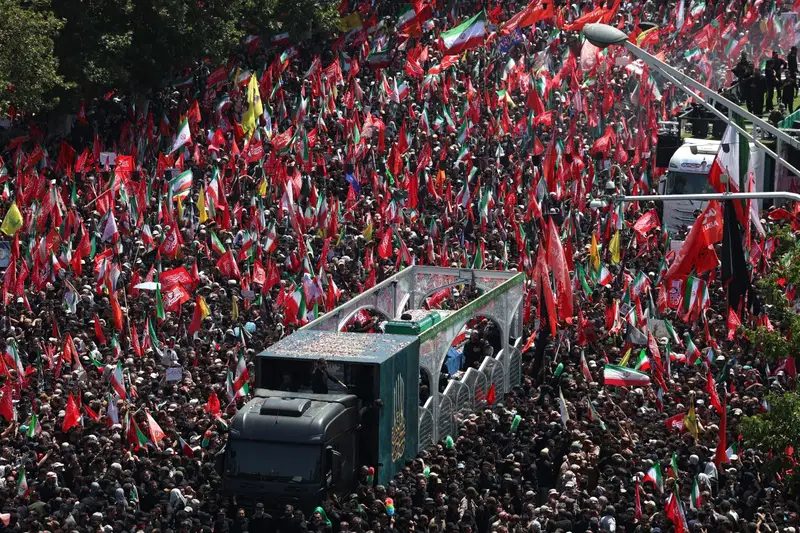
The funeral procession for Iran’s late Supreme Leader, Ali Khamenei, commenced in Tehran on Monday, according to state television, with authorities expecting a turnout that could rival the millions who attended the burial of his predecessor nearly four decades ago.
The ceremonies are being viewed as an opportunity for Iran to demonstrate resilience after five weeks of conflict with the United States and Israel, while speculation continues over the leadership of Khamenei’s successor, Mojtaba Khamenei, who has yet to make a public appearance since assuming office.
READ MORE: Sanwo-Olu, Diplomats Mark America’s 250th Independence Anniversary in Lagos
After lying in state for two days at the Grand Mosalla, Khamenei’s body began its final journey through the Iranian capital, accompanied by large crowds of mourners, state broadcaster IRIB reported.
Thousands assembled at Imam Hussein Square in eastern Tehran, where demonstrators also displayed an effigy of Donald Trump, according to state media.
Officials are determined to prevent a repeat of the disorder that overshadowed the 1989 funeral of Ayatollah Ruhollah Khomeini, which reportedly attracted around 10 million mourners. The enormous crowd led to a deadly stampede that left more than 10 people dead and over 10,000 injured.
On Sunday, thousands gathered at the Grand Mosalla to pay their final respects to Khamenei and four members of his family, who were all reportedly killed in Israeli airstrikes on February 28.
To reduce the risk of overcrowding, authorities erected large concrete barriers between the public and the coffin.
It remains uncertain how closely mourners will be allowed to approach the procession. During Khomeini’s funeral in 1989, security forces were forced to transport his body by helicopter after mourners overwhelmed the funeral vehicle, tearing the burial shroud and causing the body to fall from the casket.
Beyond honouring Khamenei, who led Iran for more than 35 years, the funeral events are also intended to reinforce the country’s image of unity and resilience following weeks of military confrontation with Israel and the United States.
Iran’s Parliament Speaker, Mohammad Bagher Ghalibaf, praised what he described on X as the unified tribute paid by the “proud and invincible nation of Islamic Iran” to its fallen leader.
The funeral programme will continue with additional processions in Qom on Tuesday, followed by ceremonies in the Iraqi holy cities of Najaf and Karbala on Wednesday, before Khamenei is laid to rest in his hometown of Mashhad on Thursday.
Three of Khamenei’s sons made a rare public appearance during Sunday’s ceremonies, drawing further attention to the continued absence of Mojtaba Khamenei, who has reportedly remained out of public view since succeeding his father.
Iranian officials have stated that Mojtaba sustained injuries during the February 28 airstrikes, although the extent of those injuries has not been disclosed.
The newly appointed commander of the Islamic Revolutionary Guard Corps, Ahmad Vahidi, attended the funeral publicly after remaining largely unseen throughout the conflict. Esmail Qaani, who heads the Guards’ overseas operations, also appeared at the ceremonies.
Although Iranian authorities have sought to project national unity, none of the surviving former presidents who reportedly had strained relationships with Khamenei have been seen attending the funeral events.
The government is also using the ceremonies to highlight public support following widespread anti-government protests earlier this year, which rights groups say were suppressed in a deadly security crackdown.
While fighting in the Middle East has paused under a ceasefire and an initial agreement between Tehran and Washington, both sides have warned they remain prepared to resume military action if necessary. Calls for retaliation have featured prominently throughout the funeral proceedings.
“The killers of Khamenei must be punished,” a mourner identified only by the surname Miremadi told AFP.
Another mourner, identified as Bakand, said, “We stand with our revolution and our leader, and we seek justice for the blood of our loved ones.”
Throughout his leadership, Khamenei maintained a confrontational stance toward Western governments, while Iran continued to support armed groups opposed to the United States and Israel, including Hamas and Hezbollah, both of which sent delegations to the funeral ceremonies.
AFP
About The Author