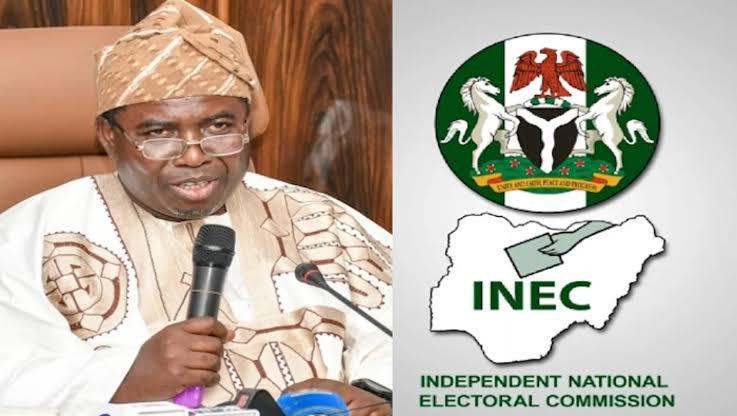
The Independent National Electoral Commission (INEC) has cautioned political parties that any primary election held beyond its stipulated May 30 deadline remains unlawful unless a superior court overturns an earlier ruling of the Federal High Court.
Speaking in an interview INEC National Commissioner and Chairman of the Information and Voter Education Committee, Mohammed Kudu Haruna, said political parties must continue to adhere to the provisions of the Electoral Act 2026 while the commission’s appeal is pending before the Court of Appeal.
READ MORE: Gunmen Demolish Homes, Abduct Pastor’s Son in Ondo Community
According to Haruna, any primary election organised after the May 30 deadline cannot be recognised under the current legal framework unless the appellate court sets aside the Federal High Court judgment that challenged aspects of INEC’s timetable.
He noted that, until a final decision is reached on the appeal, political parties should be guided strictly by the provisions of the Electoral Act.
His remarks come amid an ongoing legal battle surrounding INEC’s schedule for party primaries and candidate nominations ahead of the 2027 general elections.
Earlier, a Federal High Court sitting in Abuja and presided over by Justice Mohammed Umar invalidated portions of the electoral timetable and guidelines issued by INEC for the forthcoming elections.
In the suit filed by the Youth Party, marked FHC/ABJ/CS/517/2026, the court ruled that the commission lacked the authority to shorten timelines prescribed under Section 29(1) of the Electoral Act 2026 for the submission of membership registers and candidates’ details.
Justice Umar held that the electoral body exceeded its statutory powers by attempting to reduce deadlines expressly provided by law, stressing that INEC could not lawfully modify timelines established under the Electoral Act.
Dissatisfied with the verdict, INEC filed an appeal and sought a stay of execution, maintaining that its election timetable was issued in accordance with its constitutional mandate and responsibilities.
Prior to the court ruling, the commission had fixed April 23 to May 30, 2026, as the official period within which political parties were expected to conduct their primaries for the 2027 elections. Parties were also directed to comply with other dates contained in the revised electoral timetable.
In a related development, less than a day after INEC challenged Justice Umar’s judgment, another Federal High Court judge, Justice James Omotosho, affirmed the commission’s authority to prepare and amend election schedules.
Delivering judgment in a separate suit filed by the Social Democratic Party, marked FHC/ABJ/CS/720/2026, Justice Omotosho held that INEC possesses constitutional powers to issue election timetables and schedules of activities.
However, he emphasised that such powers must be exercised within the limits and timelines stipulated by the Electoral Act 2026.
Meanwhile, the appeal committee set up by the African Democratic Congress (ADC) in Kaduna State has directed fresh primary elections in several constituencies after reviewing petitions arising from the party’s recently concluded primaries.
Chairman of the committee, Dr. Muhammed Fagge, said the panel examined complaints, documentary evidence and submissions from aggrieved aspirants before arriving at its conclusions.
He disclosed that the committee uncovered various irregularities and alleged cases of manipulation in some of the primary elections.
As a result, several contests were declared inconclusive, while rerun elections were ordered in areas where the panel identified serious procedural violations, exclusion of qualified aspirants from ballot papers, insufficient proof of voting, and other irregularities.
For the Ikara/Kubau Federal Constituency, the committee ordered a fresh exercise after finding that Ibrahim Kubau, a properly screened aspirant, was excluded from the ballot.
Likewise, a rerun was approved for the Kaduna South Federal Constituency after the committee found inadequate evidence to confirm that voting took place across all wards in the constituency.
Fagge announced that repeat primaries would be conducted in affected wards and constituencies, including Kaura, Soba, Ikara, Kajuru, Badarawa/Malali, Magajin Gari II, Birnin Gwari, Tudun Wada West, Igabi, Kagarko, Kawo, Zaria, Chikun/Kajuru and Kudan/Makarfi, among others.
He explained that the objective was to preserve the credibility, transparency and fairness of the party’s candidate selection process.
The committee also ruled on the Kaduna North Senatorial District primary, stating that any attempt to adopt a consensus arrangement or affirmation process would be invalid unless all stakeholders involved expressly agreed to it.
Fagge stressed that every aspirant must be given an equal and fair opportunity to participate without being disadvantaged by procedural shortcomings or electoral misconduct.
Haruna’s latest comments, however, indicate that until the Court of Appeal delivers its verdict, political parties that conduct primaries outside INEC’s May 30 deadline risk having such exercises declared invalid.
About The Author