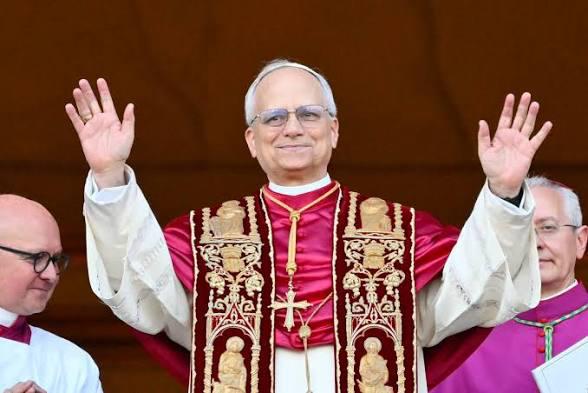
Pope Leo XIV arrived in Spain on Saturday for a week-long trip centred on migration, social justice, and reconciliation, at a time when Prime Minister Pedro Sanchez is facing mounting political challenges.
The pontiff’s visit commenced with an official reception at Madrid’s Royal Palace, where he was welcomed by King Felipe VI and Queen Letizia.
READ MORE: Senate Moves to Accelerate State Police Legislation Amid Escalating Insecurity
A major prayer gathering is scheduled later in the day near Real Madrid’s iconic Santiago Bernabeu Stadium, with organisers expecting approximately 400,000 participants.
On Sunday, an estimated one million worshippers are expected to attend an open-air Mass in central Madrid.
During his stay, Pope Leo XIV will address the Spanish Parliament and travel to Barcelona to bless the newly completed tower of the Sagrada Familia Basilica, which has become the tallest church in the world.
The Vatican also confirmed that the pope will hold private meetings with survivors of clergy sexual abuse.
A 2023 report by Spain’s national ombudsman estimated that about 200,000 minors have suffered abuse linked to members of the Catholic Church since 1940.
In March, the Spanish government and Church authorities reached an agreement to provide compensation for victims, marking a significant step after years of criticism over the Church’s handling of abuse allegations.
The pope’s itinerary also includes a visit to the Canary Islands, where he will meet migrants and humanitarian groups assisting them. Prime Minister Sanchez is expected to join him in paying tribute to thousands of migrants who have lost their lives while attempting to reach Europe.
Located off the coast of West Africa, the Canary Islands have become one of the main gateways for irregular migrants entering Spain following dangerous sea journeys from Africa.
According to the UN’s International Organization for Migration, at least 1,172 migrants died or disappeared along the route in 2025, compared with 1,215 in the previous year.
Spain has generally maintained a more welcoming immigration policy than several of its European counterparts under Sanchez’s leadership. However, the government continues to face criticism from the conservative Popular Party and the far-right Vox party, which advocates policies centred on what it calls the protection of Spain, traditional family values, and life.
At the same time, Sanchez remains under pressure over corruption investigations involving individuals within his political circle. Separate cases have implicated his wife, brother, former senior Socialist Party figures, and former Prime Minister Jose Luis Rodriguez Zapatero.
The allegations have proven politically damaging for Sanchez, who came to office in 2018 promising to restore integrity to Spanish politics after corruption scandals affected the Popular Party.
Despite repeated calls from opposition parties to step down, Sanchez has insisted he will remain in office and lead his coalition government until the next scheduled general election in 2027.
Rafael Rubio, spokesperson for the Catholic Church regarding the papal visit, noted that the pope is arriving in a deeply divided political climate.
“He is visiting a country marked by strong political polarisation, where different groups may seek to interpret the visit to their advantage,” Rubio said, adding that ensuring the pope’s message resonates across all sectors of society would be a significant challenge.
Security has been significantly tightened for the occasion, with around 15,000 officers from the National Police and Guardia Civil deployed alongside regional and local security forces.
The visit has also drawn substantial international attention, with more than 4,000 journalists from 80 countries accredited to cover the event.
The trip marks Pope Leo XIV’s first visit to a European Union member state outside Italy since becoming pontiff and the first official papal state visit to Spain since Pope Benedict XVI travelled there in 2010.
Unlike his predecessor, Pope Francis, who largely focused on the developing world, Leo XIV’s visit places renewed attention on one of Europe’s historic centres of Catholicism, where church attendance and religious participation have steadily declined in recent decades.
About The Author